

Table of Contents
Introduction
In 2025 Final Draft Mapping conducted a Geospatial Salary and Skills Survey for the island of Ireland. The survey submissions were analysed by Richardson Dzikiti with core insights presented at the AGI Northern Ireland Conference in June 2026. You can download Richardson’s presentation slides here.
At Final Draft Mapping we believe information about the geospatial industry belongs to all who’s careers help shape the future through geospatial technology. You can download a stripped down version of the data submitted here. We implore you to garner your own insights and share with the us, we would like to grow this blog post with analysis performed by the geospatial community of Ireland.
You can find 2024 survey results here.
Geospatial Salary & Skills Survey Ireland 2026
The 2026 edition of the survey is under way and can be found here. Please fill in and share to your network, peers, and colleagues. The more submissions we get the better the insights that can be generated.
The continuation of this survey is important for many reasons such as;
- Career planning
- Identifying skills gaps
- Aiding with employee retention
- Market trends
- Curriculum development
Geospatial Salary & Skills Survey Ireland 2025
On to some highlights from the 2025 Geospatial Salary & Skills for Ireland beginning with an overview of respondents.
Overview
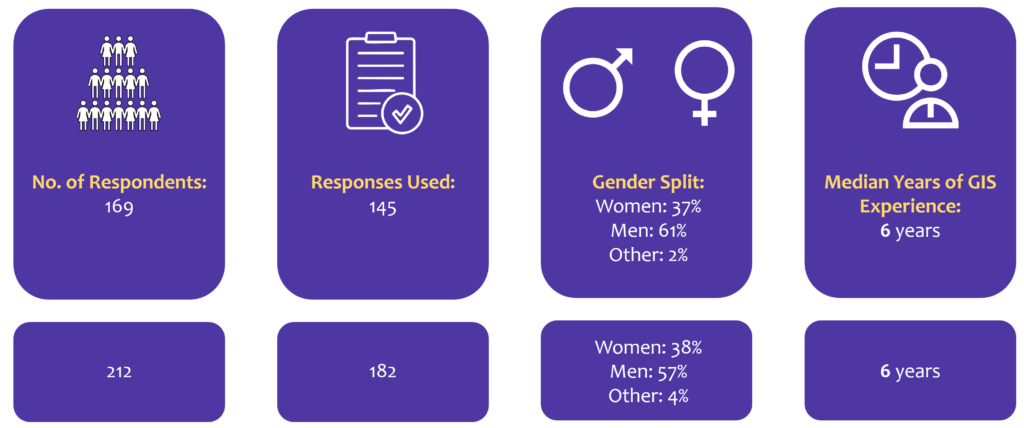
A bit down from the number of respondents last time out, something that we need to work on to promote the survey and its benefits. There are an abundance of geospatial professionals out there that we are maybe not reaching or not reminding to fill ion the survey, and of course there will be a cohort that just do not want to and that’s ok.
Although we received over 169 submissions, the survey attracts people from abroad and people using it to apply for a job. All of which are quite easy to spot. Outliers are also removed where typos in salary are evident with an extra zero added. We highly doubt a GIS Analyst is earning €500,000 a year, but if you are please contact me, I want to know where that is 😅
Salary
“Comparison is the thief of joy” – Theodore Roosevelt (but who knows who he robbed it from!)
Anyway, comparison is essential. You need benchmarks set industry standards against.
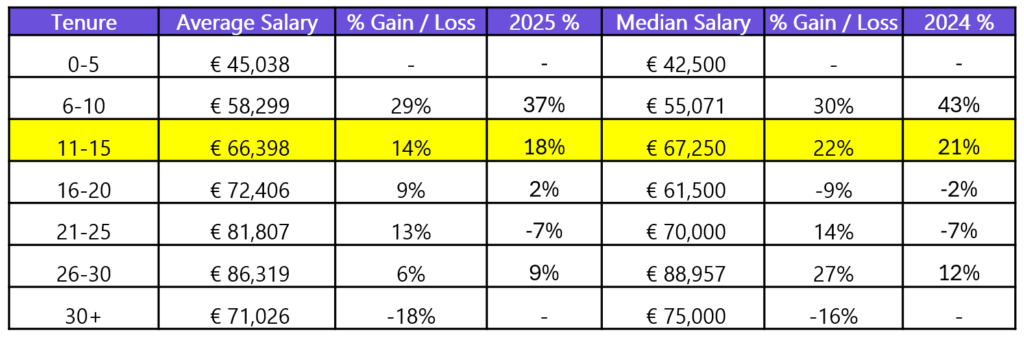
For those that use GIS 50% or more of the time during their working hours, the average salary is €55,000 with a median of €52,000.
Those with 3 or less years of professional experience (GIS 50%+) have an average salary of €40,000 with a median of €51,000. The highest three salaries are €83,000 (Project Management: Full-time), €67,750 (Geospatial Data Scientist: Full-time), €60,000 (GIS Consultant: Self-employed) with the rest €52,000 and below. The range is €26,000 to €83,000.
Those with 4-5 years of professional experience (GIS 50%+) have an average salary of €50,000 with a median of €52,000. The two highest salaries are both at €77,000 (GIS Specialist: Self-employed, GIS Consultant: Full-time). The range is €37,000 to €77,000.
Those with 6-10 years of professional experience (GIS50%) have an average salary of €55,000 with a median of €52,000. The range is €35,780 to €75,000.
Those with more than 10 years professional experience (GIS 50%+) have an average salary of €76,000 with a median of €52,500. The range is €29,105 (GIS Developer part-time) to €180,000 (Self-employed)
Highlights:
- Salaries in the Geospatial sphere continues to outperform the national average.
- Salary stagnation still being seen after 10 years as we saw in the 2024 survey.
- Gender pay-gap in geospatial continues to decrease faster than the national.
Salary Satisfaction
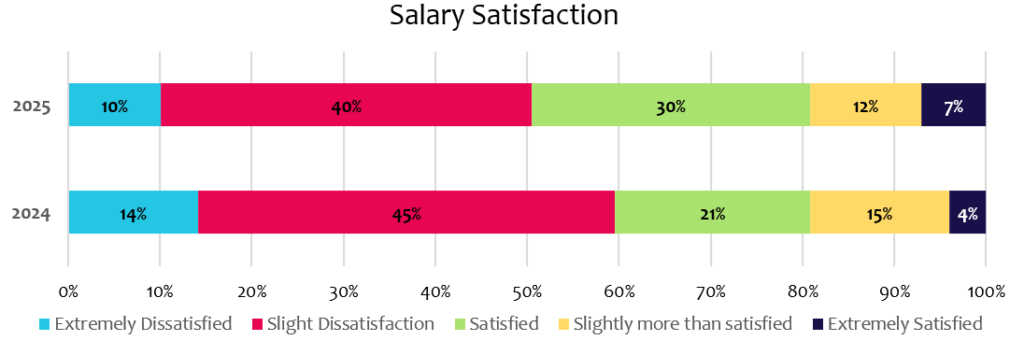
There seems to be a slight shift in overall salary satisfaction.
Those extremely dissatisfied shrunk from 14% to 10% and those with slight dissatisfaction dropped from 45% to 40%.
In 2025 the scale is balanced between those who have salary satisfaction and those who do not.
50% of respondents are still on the dissatisfied side of the market.
Skills
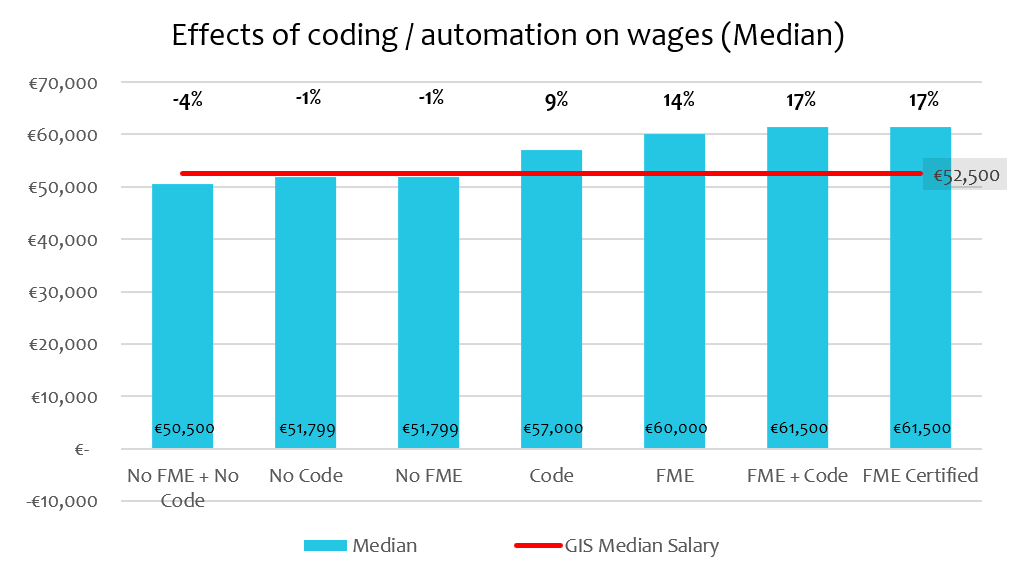
It is still evident that automation skills have a higher earning power especially with FME and programming (Python/R – but not limited to these). There is a 13% average increase in salary for those with FME and programming skills., with FME certification adding 2.5% to FME user’s median pay.
The good news is, compared to 2024, the less “technical” roles saw a larger increase in median pay with 12% increase to non-coder / FME users with a 3% increase for coders/FME users.
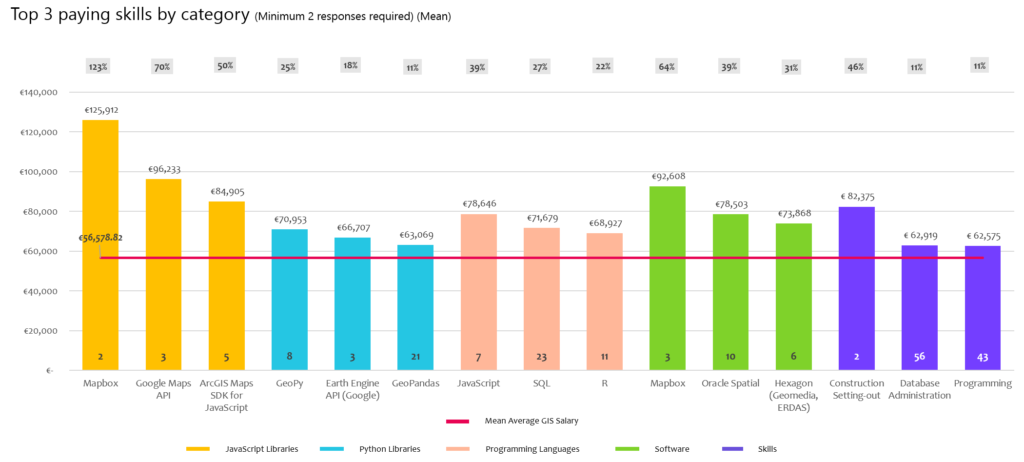
WebGIS development skills are setting the new frontier with a 29% premium on median salary for JavaScript users in 2025 and a 51.3% increase in mean pay compared to 2024 as shown below.

The graphic above poses some interesting thoughts. The open-source technologies; PostGIS, R, SQL, Python (PySAL, GeoPy), JavaScript (OpenLayers, Leaflet) have the highest average salaries, but take a look at the number of respondents, it is quite low. This would indicate that there are fewer open-source technology jobs out there, but they pay more on average. The survey showed the over 80% of respondents used Esri technology, which could indicate that these are the more common skills in demand.
Workforce
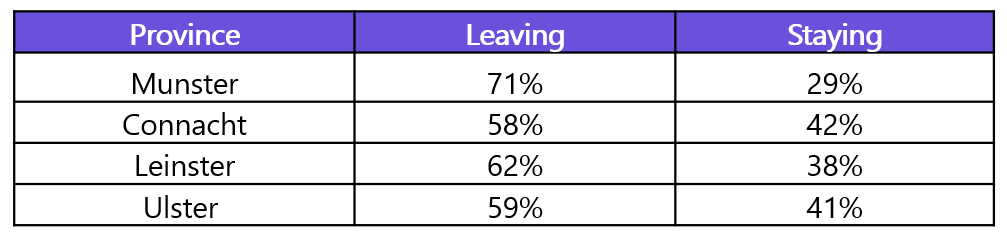
While the figures above represent an improvement in those happy to stay at their current role, the high percentage of those looking to leave is concerning and something employers need to take note of.
A big take away from Richardson’s analysis is that respondents earning less than €40,000 are the highest risk for moving jobs and that the 3 year tenure is the critical turning point with 82% of respondents looking to move on at this stage, especially if they earn less than €40,000.
The current working arrangment shows that in industry is currently flexible.
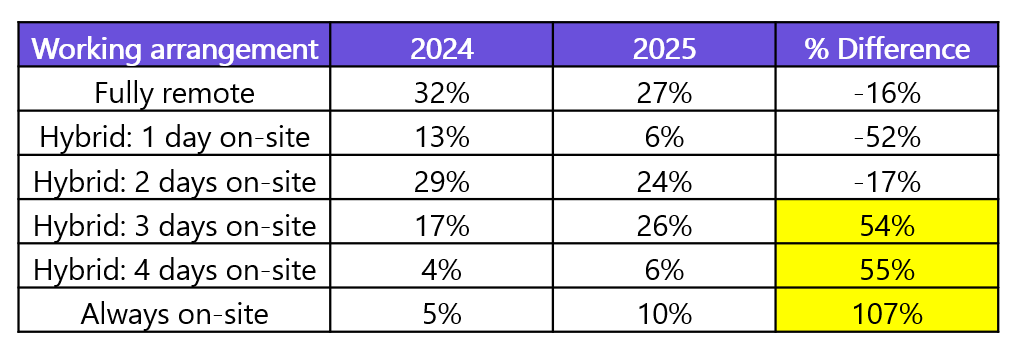
10% of respondents are always onsite in comparison to 5% the previous year. It will be interesting to monitor the working arrangements the further we move away from COVID and if the fully remote arrangement continues to go down while the higher days on site goes up.
Would you recommend a geospatial career to a young adult?
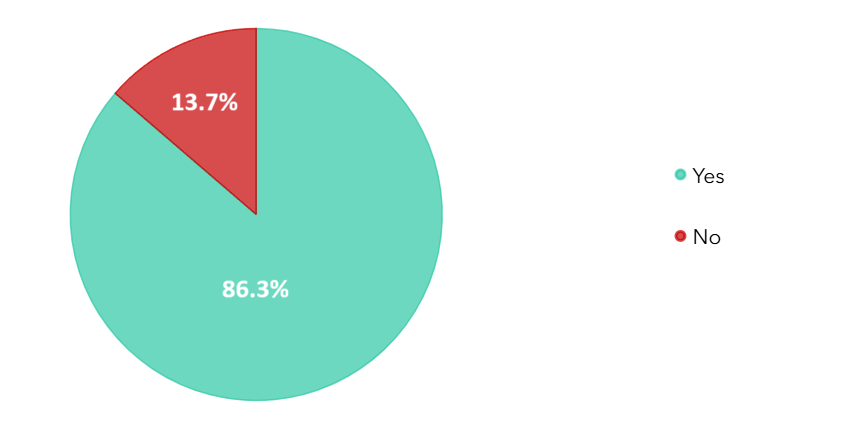
83.6% of respondents said they would.
Outro
The insights available in this post are only a selection of the more common aspects. A trimmed down version of the data is available here, and we ask you to perform your own analysis and share with us the insights that you find. Don’t forget to take this years Survey.